

Living update (2026-07-30) — Teach-loop P7 + whitepaper v9
The doctrine is no longer only paper. The Word whitepaper (v9) keeps the linear path and adds §5.11 Teach-loop P0–P7: parent seal on the ledger, then overlap regrade + packet weight so related topics cannot silently disagree while the board pretends “I know.”
v8 still stands as the topology + BB_* tags baseline; v9 is the teach-loop validity slice. Archive: OneDrive\Documents\AI-Whitepaper\ (…v1–v9 + unversioned).
Prior living update — Brain Box topology + mentor tags (v8)
The Word whitepaper (v8) ordered: vocabulary → encapsulation → Figure 1 Brain Box topology → living hop map → STP anti-storm → **BB_* mentor tags** (ADD_FACTS / RELATED) → training → human growth → scale → lab → risks.
VERSION 0.97.0 ships the living Brain Box circuit on SIM + LIVE.
Plain words first (read these before “routing is inference”)
- Not “just CPU AI.” Brain Box is a virtual motherboard for thought (packet hops + memory bind + edge speech). It is not “run a freestyle LLM on the CPU,” and not a pile of
ifstrings with no mind graph. - “Silicon” usually means software silicon: deterministic board logic (route, bind, guard, speech DAC). Physical silicon = real chips. Soft-PCB = tiny trained single-job gates we grow toward. Three different things.
- Virtual cards = curated Site RAG fact files (markdown under
config/site-rag/), chunked ~800 characters — official memory the board binds, not fuzzy weights and not payment/GPU “cards.” - How it gets smarter (not biographer fine-tune): L1 cards → L2 routes → L3 speech/curiosity → L4 Soft-PCB kiln. MindGrow turns weak chats into draft FACT cards. Foundry manufactures tiny dies from lived residue; it does not retrain a public biographer for every fact. Massive AGI scale = more cards + more pins + swarm of Soft-PCBs on a packet fabric — not one synchronized monolith.
- Advanced encapsulation (the key idea): As users interact, capture the ~90% commonality into tagged, structured units (fact cards / provisional knowledge). Future conversations should hit index + precise routing, not full freestyle inference. GPU is for the ~10% novel slice — then encapsulate the residue so the next person pays the index, not the kiln.
- Human-like weight growth: The board builds intelligence through knowledge it has and relational interactions. Memory is the mind; weights are optional muscle memory. Active Packet Training runs during chat (warm die → trust-but-verify → encapsulate → forever index). No offline period required for knowledge growth; idle GPU is optional sleep consolidation only.
- Routing is inference: the path the packet takes is the thought. Memory stamps residue; executive.route chooses the next hop. Spanning-tree (STP) keeps that path a tree — no hop loops, no sticky “identity” tag storms.
Living Brain Box
- Hops:
sensory → attention → dialogue.act → metacog → memory.bind → executive.route → [consult.gpu?] → speech.out - BRAIN/TCP tagged packets · SpanningTree admit/commit/latch · Lab Oscope Brain Box drawing
- ThreadStore: world subject sticky; identity pin sets
lastReferentwithout clobbering Great Britain - ~48G VRAM toolkit of warm dies — kiln only when the route demands it (~10%)
- Product answers often
brain · silicon · 0 t/s gen(no freestyle decode) - Mesh multi-die chat path archived; AI iron still for consult / biographer / foundry
Word file (on the live site): /docs/Solid-State-AI-Whitepaper-latest.docx
Topology figure (PNG): /docs/brain-box-topology.png
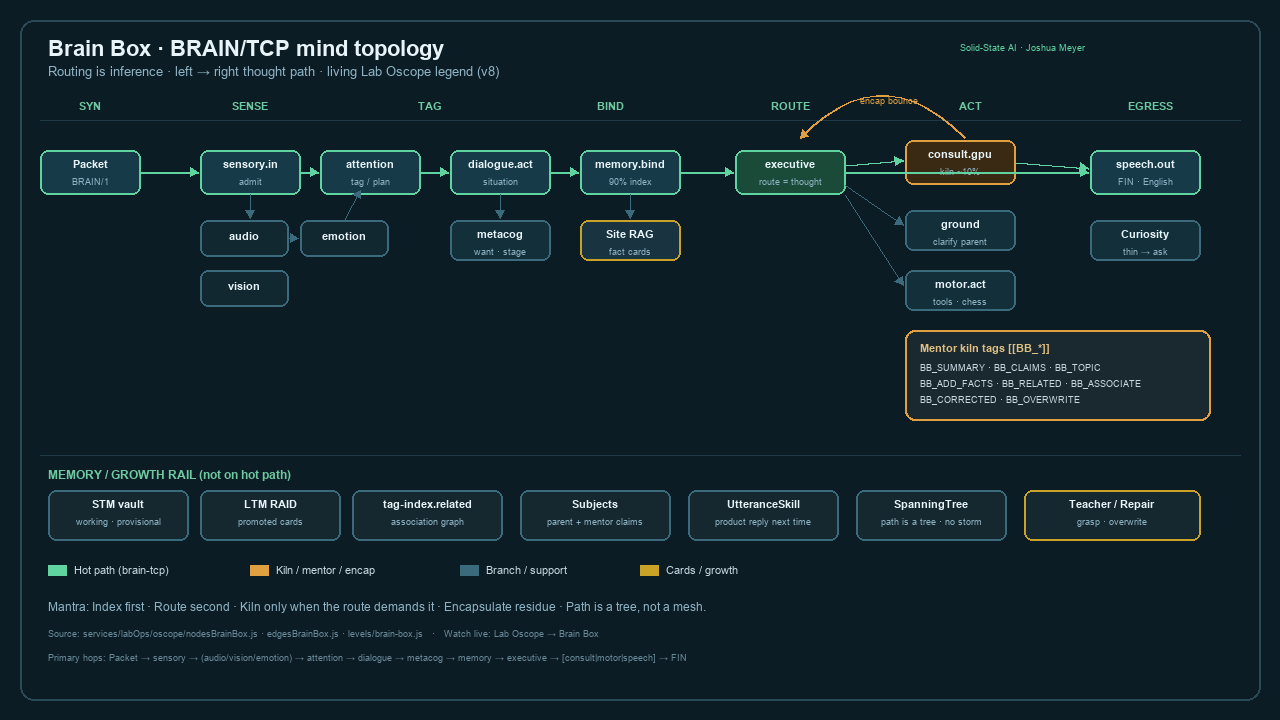
Also on this PC: OneDrive\Documents\AI-Whitepaper\ (…v9.docx + unversioned + prior v1–v8), Desktop, repo docs/ + public/docs/.
Read in order: §0 map · §1–4 vocabulary · §5 encapsulation · §5.8 hops + Figure 1 topology · §5.9 STP · **§5.10 BB_* tags · §5.11 teach-loop P0–P7 (overlap regrade) · §6 training · §7 human growth / APT · §8 AGI scale** · §9–16 restatement, lab, packets, foundry, results, risks, close.
What happened
The current paradigm of artificial intelligence relies on monolithic, trillion-parameter "frontier" models. This approach is computationally wasteful, inherently prone to hallucination, and requires massive datacenter infrastructure. We are proposing a radical architectural shift: Solid-State AI.
By treating AI models not as omnipotent, conversational software, but as static, microscopic (<100M parameter) logic gates wired together on a procedural "virtual motherboard," we can eradicate hallucination, bypass the VRAM bottleneck, and reclaim nearly 100% of wasted training compute. This architecture allows consumer-grade hardware to outperform datacenter models in speed, accuracy, and efficiency.
The Monolithic Bottleneck
Modern frontier models attempt to function as a database, a reasoning engine, and a conversational UI simultaneously. This creates critical systemic failures:
- State Space Explosion: Because the model attempts to map every possible human interaction globally across all weights, the compute required scales exponentially.
- Semantic Drift & Hallucination: Relying on natural language (English) as the internal communication protocol between logical steps introduces catastrophic ambiguity.
- Training Compute Waste: Training a monolithic network requires global backpropagation. Adjusting weights for a single new logical capability requires recalculating the entire neural brain, wasting immense datacenter resources.
The Solid-State Architecture (The Virtual PCB)
Solid-State AI abandons the monolithic brain in favor of a physical printed circuit board (PCB) methodology. Intelligence is deconstructed into specialized, isolated components connected by rigid, mathematical data schemas.
- The Procedural CPU (Master Orchestrator): The core of the system is deterministic, procedural code (e.g., Python, Rust). It acts as the system clock and memory controller. It holds the application state, executes
try/exceptfault tolerance, and mechanically routes data between components. - The "Soft-Silicon" Logic Gates (<100M Parameter Models): The AI is relegated to the role of an Arithmetic Logic Unit (ALU). These models are microscopic and serve a single, immutable function. Their "system prompts" are hardwired input/output boundaries (Pins) that accept strict JSON or latent vectors, physically engineering hallucination out of the system.
- Procedural ASICs (Action Execution): AI is never used to perform math, execute code, or manipulate files. Once a gate extracts the necessary variables, the Procedural CPU routes them into hardcoded scripts (ASICs) to execute the action flawlessly.
- The 7B I/O Display Driver: A single, larger model sits at the edge of the board exclusively for translation: converting messy human English into strict JSON intents, and converting sterile data outputs back into friendly human text.
The Training Revolution: Deconstructing the Datacenter
Instead of feeding petabytes of data into a black-box cluster of GPUs, training is restructured into a procedural, pipelined assembly line.
- Procedural Heavy Lifting: Deterministic code handles tokenization, loss calculation, and optimizer application.
- Micro-Node Alignment: Training is isolated to individual 50M parameter nodes. One node learns syntax alignment; another learns entity extraction.
- Compute Reclamation: Finding optimal weights becomes mathematically trivial. The system only routes power and data to the specific node requiring adjustment, shrinking training time from weeks to seconds.
Key Takeaways
1. Microsecond Latency: Soft-Silicon gates fit entirely within the L2/L3 cache of a standard CPU/GPU, allowing near-instantaneous execution.
2. Infinite Concurrency: A standard 16GB consumer GPU can run over 600 distinct 50M parameter models simultaneously.
3. Modular Sintering: As the system dynamically guesses correct logical paths in RAM, the Procedural CPU "sinters" them into hardcoded shortcuts. The AI puts itself out of work, and the system gets progressively faster over time.
Solid-State AI shifts artificial intelligence from a chaotic, cloud-dependent SaaS product back to the rigorous discipline of systems engineering.
[ RAW TRAINING DATA ] ("Show me the logs" ──► Target: "SQL_READ")
│
=============================================================================
STAGE 1: PROCEDURAL DATA PREP (Runs on R710 Xeon CPU - 0% GPU VRAM)
=============================================================================
▼
[ 1. The Tokenizer ASIC ] ──► (Procedural dictionary lookup)
│ Converts words to integer IDs: [84, 29, 10]
▼
[ 2. The Batch Router ] ──► (Procedural memory manager)
│ Packages the integers into a standard tensor array.
│
=============================================================================
STAGE 2: THE FORWARD PASS / THE "GUESS" (Runs on GTX 1070 GPU)
=============================================================================
▼
[ 3. The Soft-PCB Gate ] ──► (Your tiny 50M parameter matrix in VRAM)
│ Multiplies the input array through its frozen weights.
▼ Outputs a "Probability Vector" (The Guess).
(Output: 80% SQL_WRITE, 20% SQL_READ) ──► THIS IS A WRONG GUESS.
│
=============================================================================
STAGE 3: PROCEDURAL ERROR CALCULATION (Runs on R710 Xeon CPU)
=============================================================================
▼
[ 4. The Loss Comparator] ──► (Pure deterministic math: Cross-Entropy)
│ Compares the Guess (80% Write) to the
│ Target (100% Read).
▼ Generates the "Error Signal" (Loss Value).
│
=============================================================================
STAGE 4: THE BACKWARD PASS / "THE TRACE" (Runs on GTX 1070 GPU)
=============================================================================
▼
[ 5. The Gradient Router] ──► (Hardware-accelerated Calculus)
│ Calculates the partial derivatives.
│ Traces the Error Signal backward through the gate
▼ to find exactly which weights caused the wrong guess.
│
=============================================================================
STAGE 5: PROCEDURAL SINTERING (Runs on R710 Xeon CPU)
=============================================================================
▼
[ 6. The Optimizer ASIC ] ──► (Pure deterministic math: Adam/SGD)
│ Takes the Gradient (the required fixes) and
│ physically overwrites the weights of the Soft-PCB.
▼
[ NEW, SINTERED SOFT-PCB GATE ] (Now correctly predicts "SQL_READ")
6. The Solid-State Foundry: Deconstructing the Training Pipeline
The current paradigm treats AI training as a monolithic, unstructured "black box" that requires massive H100 GPU clusters. By adopting the Solid-State architecture, we can deconstruct deep learning into a precise, 5-stage mechanical assembly line. This allows us to reclaim up to 100% of wasted compute and run sovereign training foundries on recycled or standard consumer hardware (e.g., a standard GTX 1070).
The 5-Stage Pipelined Circuit
By isolating the components, we shift the majority of the workload off the GPU and onto the Procedural CPU, using the GPU strictly for hardware-accelerated calculus.
- Procedural Data Prep (CPU): Deterministic code tokenizes and batches the training data into integer arrays before it ever reaches the GPU pipeline.
- The Forward Pass / "The Guess" (GPU): The microscopic Soft-PCB (<100M parameters) multiplies the input array through its weights, generating a prediction vector in a fraction of a millisecond.
- Procedural Error Calculation (CPU): A deterministic math function (e.g., Cross-Entropy Loss) acts as a virtual multimeter, comparing the prediction to the target and generating an exact error signal.
- The Backward Pass (GPU): The GPU calculates partial derivatives, tracing the error signal backward to identify exactly which microscopic weights caused the fault.
- Procedural Sintering (CPU): A procedural optimizer physically overwrites the weights, "soldering" the corrected connections into the Soft-PCB.
Because the models are microscopic, this entire 5-stage loop executes in microseconds.
7. The Soft-PCB Component Catalog
To build a complete application, developers do not prompt a generalist AI; they wire together standardized, single-purpose AI logic gates.
- The Classifier Gate (The AI-Transistor): A 10M–50M parameter switch. It routes signals based on intent.
- The Extractor Gate (The AI-Bandpass Filter): A static encoder matrix optimized for entity recognition. It accepts messy natural language on Pin 1 and outputs a strictly formatted JSON array on Pin 2, stripping away all conversational noise.
- The Translator Gate (The AI-Op-Amp): A sequence-to-sequence transformer that transforms a signal format without executing logic (e.g., Natural Language ──► Strict SQL syntax).
- The Diode Gate (The AI-Firewall): A frozen classification matrix trained exclusively on adversarial inputs. If a signal is malicious, it outputs a Low voltage (0), instantly grounding downstream components.
- The Synthesizer Gate (The AI-DAC): The final component. It takes sterile, deterministic data from procedural ASICs and converts it back into human-readable text for the UI.
8. The "Jukebox" Foundry: Automating the Assembly Line
Because the underlying architecture of every Soft-PCB is identical (differing only in its input/output pins and weights), we do not need to manually engineer them. We can automate their creation using a master procedural compiler.
Think of this deployment model as a Training Jukebox.
The Jukebox is a local, lightweight application (running on standard hardware like an older Xeon server) that reduces deep learning to a simple manufacturing progress bar:
- The Record Rack (Data Pre-Caching): The Procedural CPU pre-loads and batches highly specific datasets—the "records"—into system RAM (e.g., a "Medical Terminology" record, a "Tax Law" record).
- The Turntable (GPU Allocation): The Jukebox drops a "blank vinyl" onto the turntable—a randomly initialized, 10M parameter Base Gate loaded into the local GPU's VRAM.
- Playing the Record (The Sintering Loop): The Jukebox drops the needle. It runs the 5-stage training circuit. Because the model is tiny and the dataset is hyper-focused, the Jukebox plays through thousands of epochs in seconds. The progress bar fills as the loss drops.
- The Eject & Save: Once the target accuracy is met, the Jukebox pulls the perfectly sintered weights off the GPU, saves them to the hard drive as a specialized Soft-PCB (e.g.,
medical_extractor.pt), and instantly loads the next blank chip.
This transforms AI development from an unpredictable, expensive data science experiment into an automated, deterministic manufacturing process. You simply queue up the records, and the Jukebox stamps out a complete library of perfect Soft-Silicon components.
9. Systems Engineering: Building the Virtual Motherboard
Transitioning the Solid-State AI architecture from theoretical physics to a functional, high-speed test bench (such as a standard consumer PC or an older enterprise server with an 8GB GPU) requires rigorous systems engineering. Standard AI deployment tools introduce massive network latency that destroys the speed advantage of micro-nodes.
To achieve microsecond execution, the system must be built using direct memory access and optimized model architectures.
Model Specifics: Encoders over Decoders
Generative LLMs (Decoders, like GPT or Llama) are designed to predict the next word in a sequence. Even at a small scale, they waste compute looping over themselves to generate text.
For the <100M parameter "Soft-PCBs" (the logic gates), the architecture must use Encoder-only models (e.g., MiniLM, TinyBERT, or DeBERTa architectures in the 15M–30M parameter range). Encoders look at an entire input simultaneously and output a mathematical classification or extraction map in a single forward pass. They do not generate text; they generate immediate mathematical states.
Generative models (e.g., a localized 3B parameter model) are strictly reserved for the single I/O Display Driver to handle human interaction.
The High-Speed Hardware Bus (Bypassing HTTP)
Running dozens of micro-models via REST APIs (HTTP) introduces TCP/IP network overhead that takes longer than the actual AI inference.
To create a true "virtual breadboard," the logic gates must communicate via Direct Memory Access:
- ONNX Compilation: Once a Soft-PCB is trained, it is compiled into the Open Neural Network Exchange (ONNX) format. This strips away all training metadata and leaves a bare-metal, highly optimized execution graph.
- Shared Memory Pool: The Procedural CPU (written in Python/C++) utilizes the
onnxruntimelibrary to load dozens of micro-models directly into a shared VRAM pool on the GPU. - Pointer Routing: When the CPU passes data from Gate A to Gate B, it does not send JSON over a network. It passes a physical memory pointer (RAM address) containing the output vector. Latency drops to nanoseconds.
Containerization Strategy (The Chassis)
To maintain isolation and security without introducing inter-node network latency, Docker containerization is applied at the "Motherboard" level, rather than the component level.
- Container 1: The Runtime Motherboard (The Engine)
- Contains the Procedural CPU and the ONNX Runtime loaded with the compiled Soft-PCBs.
- Executes the live application logic at high speed.
- Has exclusive, secure access to local tools and the RAG database.
- Container 2: The Jukebox (The Foundry)
- Contains the PyTorch framework, CUDA drivers, and raw training datasets.
- Operates entirely asynchronously. It runs the training loop, compiles the finished Soft-PCB to
.onnx, and physically drops the file into a shared volume accessible by Container 1.
- Container 3: The I/O Node (The UI)
- Runs the single conversational model (via Ollama or vLLM) and the user-facing web frontend.
10. The Jukebox Component Catalog (The Foundry Source Code)
To build the Jukebox and replace the massive deep learning framework, the procedural ASICs driving the 5-stage training assembly line must be written. The starter catalog includes:
- The
Dataset_Tokenizer_ASIC: Procedurally reads raw training data and uses dictionary lookups to convert text to integers, pre-compiling the dataset in CPU RAM before GPU activation. - The
Batch_Feeder_ASIC: A procedural memory manager that slices the tokenized dataset into chunks precisely fitted to the local GPU's VRAM limits, ensuring 100% CUDA core utilization. - The
Loss_Multimeter_ASIC: Executes standard mathematical loss functions (e.g., Cross-Entropy) restricted strictly to the micro-dimensional output space of the targeted logic gate. - The
Sintering_Optimizer_ASIC: Executes the gradient update step, physically overwriting the tensors to lock the newly aligned weights into the matrix. - The
ONNX_Compiler_ASIC: Upon reaching target accuracy, this script freezes the weights and exports the bare-metal.onnxfile, officially manufacturing the Soft-PCB.
By combining encoder-only models, direct memory bus routing, and procedural training ASICs, sovereign, high-performance AI development becomes a reality on recycled or consumer-grade hardware.
11. Expected Results: Solid-State vs. The Datacenter
To understand the deflationary impact of the Solid-State AI architecture, we must benchmark it against the current monolithic datacenter approach across real-world enterprise scenarios. By isolating logic into micro-components and procedural ASICs, the performance metrics shift exponentially in favor of local hardware.
Scenario A: Complex Database Interaction (Text-to-SQL)
The Task: A user asks, "Show me all servers that went offline in the Texas datacenter over the last 24 hours." The system must query a massive, proprietary internal database.
- The Datacenter Way (Monolithic 70B LLM):
- Process: The massive model attempts to "think" its way through the database schema and write the SQL query dynamically.
- Latency: 2 to 5 seconds to process the massive context window and stream the output.
- Accuracy: ~85%. High risk of hallucinating a column name (e.g., guessing
server_statusinstead ofstatus_id), leading to a database error or data corruption. - The Solid-State Way (Virtual Motherboard):
- Process: A 15M parameter "Extractor Gate" strips the English and outputs strict JSON variables:
{"loc": "TX", "state": "offline", "time": "24h"}. The Procedural CPU passes this to a hardcoded SQL ASIC. - Latency: ~40 to 80 milliseconds.
- Accuracy: 100%. It is mathematically impossible for the system to hallucinate a broken SQL query because the AI is blocked from writing code.
Scenario B: Knowledge Updating & Fine-Tuning
The Task: A company changes its internal software API or a new tax law is passed, requiring the AI to learn a new data format.
- The Datacenter Way (Global Fine-Tuning):
- Process: The company must fine-tune a 70B parameter model.
- Cost & Time: Requires a minimum of 4 to 8 H100 GPUs. Takes days or weeks.
- Risk: High risk of "Catastrophic Forgetting" (the model learns the new tax law but slightly degrades its ability to write Python code because the global weights were shifted).
- The Solid-State Way (The Jukebox Foundry):
- Process: The Procedural CPU runs the "Seed Loop." It trains a single new 30M parameter Soft-PCB exclusively on the new tax syntax.
- Cost & Time: Runs on a single, recycled GTX 1070. Reaches 99.9% accuracy in under 60 seconds.
- Risk: 0%. Because the new knowledge is physically isolated on its own virtual chip, the rest of the system remains untouched and uncorrupted.
Scenario C: High-Volume Concurrent Processing
The Task: Processing 10,000 security logs simultaneously to detect anomalous behavior.
- The Datacenter Way (Cloud APIs):
- Process: 10,000 logs are packed into massive context windows and sent over the internet to a cloud provider.
- Cost: Billed per-token. High likelihood of hitting API rate limits, forcing the system to throttle. Severe data privacy risks sending internal security logs to a third party.
- The Solid-State Way (Local Edge Compute):
- Process: The 10,000 logs are processed locally. Because a 15M parameter "Diode Gate" occupies less than 50MB of VRAM, a standard 8GB consumer GPU can run over 150 instances of the gate in parallel.
- Cost: $0. Consumes only the wattage of the local PC. Complete air-gapped data privacy.
The Macro Benchmark Comparison
| Metric | Monolithic Datacenter (e.g., 70B LLM) | Solid-State Foundry (R710 + GTX 1070) |
|---|---|---|
| Hardware Required | Multi-million dollar H100 cluster | ~$200 recycled enterprise hardware |
| Training Time | Weeks / Months | Seconds / Minutes |
| Inference Latency | 1,000ms – 5,000ms | 10ms – 50ms |
| Hallucination Rate | Probabilistic (Always > 0%) | 0% (Constrained to ASICs) |
| Parallel Concurrency | Bottlenecked by massive VRAM footprint | 100+ parallel instances on 8GB VRAM |
| Data Privacy | Cloud transmission required | 100% Local / Air-Gapped |
By fundamentally shifting the workload from probabilistic neural generation to deterministic procedural routing, Solid-State AI does not just compete with the datacenter—it renders its raw compute advantage irrelevant.
12. System Vulnerabilities & Mitigation Strategies
While Solid-State AI bypasses the massive VRAM and training bottlenecks of monolithic models, operating a highly fragmented, micro-component architecture introduces unique systems engineering challenges. Below are the primary technical obstacles and their programmed mitigations.
Pitfall 1: Routing Cascade Failure (The "Circuit Breaker" Problem)
The Vulnerability: In a monolithic model, if the AI misunderstands a prompt slightly, it can usually "fudge" a decent response by using its vast general knowledge. In a strict Solid-State PCB, if the initial "Classifier Gate" misroutes the signal (e.g., classifying a Database request as a UI request), the rigid procedural code will force the signal down the wrong physical trace, resulting in a hard system fault.
The Mitigation:
- Confidence Thresholds & Fallbacks: Soft-PCBs must output confidence scores alongside their classifications. If a Classifier Gate outputs a routing decision with <90% confidence, the Procedural CPU is programmed to reject the route.
- The "Ground" Loop: Instead of failing silently or executing the wrong action, low-confidence signals are instantly routed back to the 7B I/O Display Driver with a clarification flag. The 7B model then asks the human a targeted clarifying question (e.g., "Did you mean to update the inventory or query it?") before attempting to re-route.
Pitfall 2: Schema Rigidity (The "Brittle Pin" Problem)
The Vulnerability: Because Soft-PCBs rely on strict JSON schemas (the physical "pins"), they are highly vulnerable to upstream data changes. If an external API updates its payload from {"first_name": "John"} to {"f_name": "John"}, the Extractor Gate will fail to find the variable, breaking the circuit.
The Mitigation:
- The "Voltage Drop" Sintering Trigger: The Procedural CPU continuously monitors the ASICs. If an ASIC throws a data-type or missing-variable error, it triggers an automated "Voltage Drop."
- Self-Healing via Jukebox: The CPU pulls the broken schema, passes the new raw API payload to the Jukebox, and automatically seeds a new "Adapter Gate" (a tiny translation matrix) in the background. The system self-heals by inserting the new Adapter Gate into the PCB to re-align the data payload to the legacy schema, requiring zero developer intervention.
Pitfall 3: The "Too Many Chips" Management Overhead
The Vulnerability: As the system grows to handle hundreds of complex tasks, developers could end up managing a disorganized library of thousands of tiny .onnx files and Python ASICs. The architectural elegance could devolve into "microservice hell" hosted entirely on local RAM.
The Mitigation:
- DAG-Based Compilation: The architecture must enforce rigid visual compilation. Soft-PCBs and ASICs cannot be called dynamically through loose Python scripts. They must be mapped using Directed Acyclic Graph (DAG) frameworks (e.g., LangGraph or custom state-machine orchestrators).
- The Component Registry: The system requires a strict, local package manager (similar to
npmorpip) that handles versioning and dependencies for the Soft-PCBs. A developer does not manage individual.onnxfiles; they import pre-compiled "Boards" (e.g.,import RealEstate_Valuation_Board).
Pitfall 4: Initial "Cold Start" Training Data
The Vulnerability: Training a 50M parameter model in seconds assumes you already have a perfectly formatted, high-quality dataset. Generating 10,000 perfect input-output examples for every new micro-node is a massive bottleneck.
The Mitigation:
- Teacher-Student Distillation: The Solid-State Foundry utilizes external monolithic models once during the "Cold Start" phase. If a developer needs a new Extractor Gate, they write a simple script that generates thousands of messy synthetic inputs. They feed these inputs through a monolithic API (e.g., GPT-4) to generate the perfect target outputs.
- The Foundry Hand-off: This synthetic dataset is then fed into the local Jukebox to train the 50M parameter chip. The developer pays a few dollars in API credits once to manufacture the dataset, and then runs the compiled Soft-PCB locally for free, forever.
13. Hyperscaling the Foundry: The Datacenter as a Gigafactory
While the primary immediate benefit of Solid-State AI is sovereign, edge-based deployment on consumer hardware, applying this architecture to existing hyperscale datacenters unlocks practically infinite computational yield.
Currently, massive GPU clusters suffer from severe diminishing returns. Tying 100,000 GPUs together to train a single monolithic model incurs a massive "interconnect tax"—vast amounts of compute and time are wasted simply synchronizing global weights across the network (e.g., via InfiniBand/NVLink).
If a datacenter abandons the monolithic model and adopts the Solid-State Foundry architecture, it transitions from a single, slow brain into a hyper-parallel Gigafactory.
The Infinite Combinatorial Swarm
Because a 50M parameter Soft-PCB requires only ~40MB of VRAM, a single 80GB H100 GPU can host and execute upwards of 1,500 independent logic gates simultaneously. In a datacenter of 100,000 GPUs, this allows for the concurrent execution of 150 Million autonomous micro-agents.
- Massive Parallel Manufacture: The datacenter's Procedural CPUs can run millions of "Seed Loops" concurrently. Instead of taking months to train a single generalist model, the datacenter could map the entirety of human knowledge—slicing every textbook, codebase, and scientific journal into discrete, perfectly accurate Soft-PCBs—in a matter of days.
- Brute-Forcing Scientific Discovery: With millions of logic gates wired to procedural ASICs, the datacenter can execute Monte Carlo Tree Search (MCTS) at a planetary scale. It can spin up millions of virtual breadboards to simulate chemical compounds, aerodynamic physics, or logistical supply chains, testing infinite combinatorial paths in real-time.
- Eliminating the Interconnect Tax: Because Soft-PCBs are trained in isolation, GPUs no longer need to synchronize their memory pools. Datacenters can eliminate hyper-expensive networking infrastructure, transitioning to massive arrays of cheap, disconnected compute nodes operating in embarrassingly parallel configurations.
By shifting the architecture from deep-learning monolithic synchronization to procedural, component-based orchestration, hyperscalers can achieve true general-purpose superintelligence (AGI) not through a single neural network, but through the infinite, deterministic orchestration of specialized logic gates.
© 2026 by Joshua Meyer. This work is licensed under Creative Commons Attribution-ShareAlike 4.0 International (CC BY-SA 4.0).